

Quick takeaways
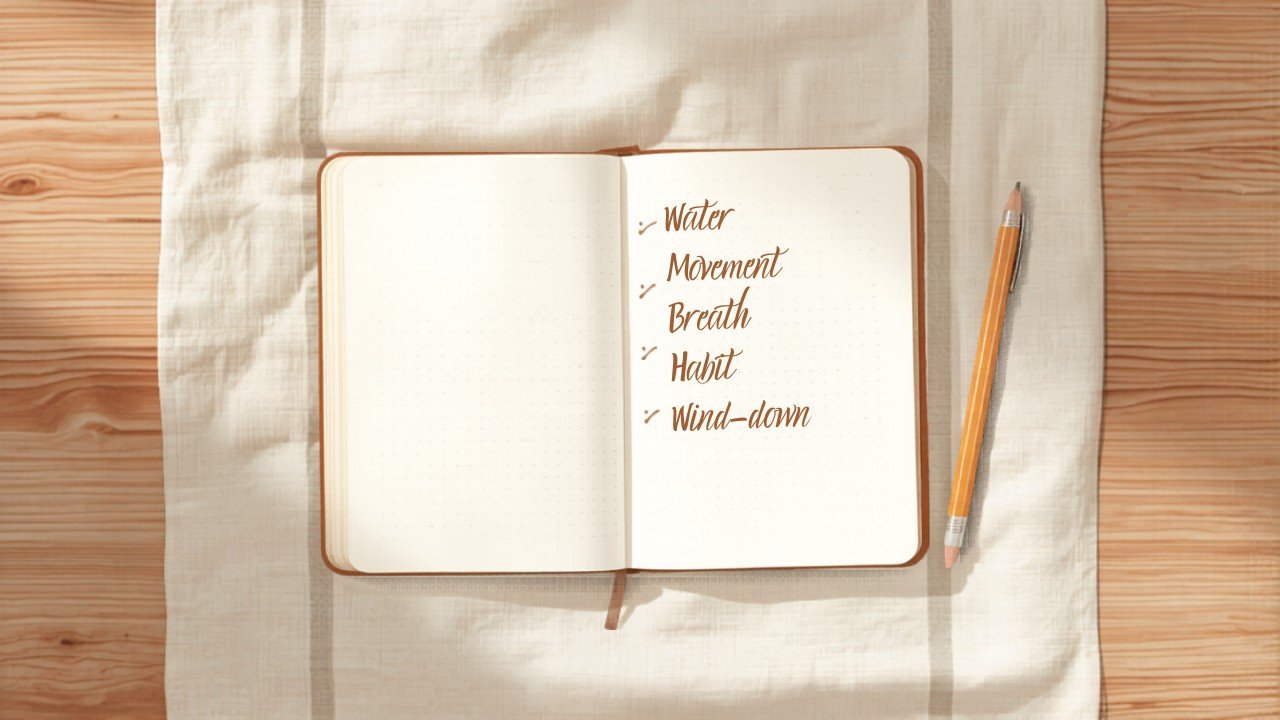
- Start with anchors: A wellness routine for beginners is 5 simple daily moves — water, movement, breath, anchor, wind-down.
- 10 minutes is enough: The whole routine fits in 10 minutes on your worst day. That’s the floor.
- Habits beat motivation: Stack each new habit onto something you already do, so showing up doesn’t take effort.
- Falling off is data: When you miss, restart the floor. Don’t restart your whole life.
- Track lightly: Three days a week beats one perfect week followed by a month off.
Some mornings I just don’t feel it.
If you’re starting from scratch — or starting over for the fifth time — the answer isn’t more motivation. It’s a smaller plan you can hit on a hard morning.
In this guide, I’ll walk you through how to start a wellness routine for beginners. The plan is five simple anchors: water, movement, breath, a habit anchor, and a wind-down step. The whole thing fits in 10 minutes. You can do it before coffee.
I’ll also show you what to do when you fall off (you will), how to track it without spreadsheets, and the one mindset shift that finally made mine stick.
Grab the free 7-Day Beginner Wellness Reset at the end if you want the printable version. ✨

What is a beginner wellness routine?
A beginner wellness routine is a small set of daily habits — like drinking water, moving for 10 minutes, and going to bed at a consistent time — that build a baseline of health without overwhelming you. The goal isn’t perfection. It’s consistency on your worst day.
It’s not a workout plan. It’s not a strict regimen. And it’s definitely not a 30-day challenge that ends with you back where you started.
Think of it as the floor under your day. When energy is high, you’ll do more. When energy is low, you’ll still hit the floor. That floor is what makes a routine stick.
Most beginners over-engineer this. They build a routine for the version of themselves they wish they were. Then they miss two days, feel guilty, and quit.
The version that works is smaller than you think.
The 5 anchors of a simple wellness routine
Every beginner-friendly routine I’ve tested comes down to five anchors. Five — not fifty.
- Hydration anchor — One glass of water (8 to 12 oz) before coffee.
- Movement anchor — 10 minutes of low-impact movement. Stretching, a short walk, or a few gentle yoga poses.
- Breath anchor — 60 seconds of slow breathing. Four seconds in, six seconds out. Sit on the edge of the bed.
- Habit anchor — One small habit you want to add: a vitamin, a journal line, a posture reset. Stack it onto something you already do — brewing coffee, brushing teeth, walking to your desk.
- Wind-down anchor — Lights down 30 minutes before bed. Phone outside the bedroom by 9:30 PM.
Why these five? Because each one supports a different part of the day — morning energy, body, breath, intention, sleep — and none of them depend on motivation.
The habit anchor is the secret weapon. You don’t have to remember to do the new thing. You just do it right after the old thing. That’s why habit anchors beat motivation every time.
Five anchors, every day, even when you don’t feel like it. That’s the whole routine.
How to start your wellness routine in 10 minutes a day
Here’s the 10-minute version. Timed. You can do it before your first sip of coffee.
- 0:00 – 0:30 — Glass of water as soon as your feet hit the floor. Skip the phone for 30 seconds.
- 0:30 – 1:30 — 60 seconds of slow breathing. Sit on the edge of the bed.
- 1:30 – 6:30 — 5 minutes of movement. Stretch, do a short walk in place, or run through five gentle yoga poses. Pick the one that matches your energy.
- 6:30 – 8:30 — Habit anchor. Two minutes. Whatever you’re stacking — journal line, vitamin, planner — do it now.
- 8:30 – 10:00 — Set tonight’s wind-down trigger. 90 seconds. Put a sticky note on your phone that says “outside the bedroom at 9:30.”
That’s it. Ten minutes. Five anchors.
It works when you’re tired because nothing in it requires being fully awake yet. The CDC’s adult activity guidelines confirm that any amount of daily movement counts — short bouts add up. You don’t need a 60-minute workout to make this real.
If you want to pair the movement anchor with a real beginner workout, here’s the workout I pair with this routine.
What to do when you fall off (your worst-day plan)
You’re going to miss a day. Maybe three. That’s normal.
Here’s what I wish someone had told me sooner:
Falling off isn’t failure. It’s data.
When you miss, don’t restart on Monday. Restart today, even at 9 PM. And cut the routine to the floor:
- Water. One glass.
- Movement. Two minutes. Any movement.
- Wind-down. Lights down 30 minutes before bed.
That’s the worst-day floor. Three things. Maybe four minutes total.
Run the floor for three days in a row. Then add one anchor back. Then another. By the end of the week, you’re back on the full routine without the guilt loop.
The reason most beginners quit isn’t the routine — it’s the restart story they tell themselves. “I already missed Monday, so I’ll start fresh next week.” That gap doubles in size each time.
The floor is small enough that the gap never gets to grow.
How to track your routine without making it complicated
You don’t need an app. You don’t need a spreadsheet. You don’t even need a journal.
The simplest tracker that works:
- A sticky note on the bathroom mirror with the 5 anchors.
- One check mark per anchor, per day.
- One 5-minute review on Sunday — what worked, what didn’t, what’s next.
That’s it. If you’d rather use an app, pick one that lets you check off five anchors in under 30 seconds. The Notion tracker I built does this with one tap, but a paper checklist works just as well to start.
The mistake most beginners make is treating tracking like a project. They spend more time setting up the tracker than running the routine. Then the tracker quits before they do.
Keep it light. Three days a week is enough data to spot patterns. You don’t need to track every single thing every single day. You need to show up, and check it off when you do.
The mindset shift that makes the routine stick
Here’s the shift that finally made mine stick:
The goal isn’t to feel like a wellness person. It’s to do five small things, most days.
Motivation isn’t what gets you started. The routine is. Motivation comes after — once you’ve done the thing three or four times and noticed you feel a little better, a little steadier, a little more like yourself.
The first two weeks are the hardest because you’re running on the routine alone, without the reward yet. That’s normal. Trust the floor.
If you’ve been waiting to “feel ready,” that’s exactly the trap. Ready is a feeling that comes after the action, not before it. Do the 10-minute version tomorrow even if you don’t feel ready. Especially if you don’t.
I broke this idea down further in where I broke down the simple 4-step baseline — read that next if the mindset piece is what keeps tripping you up.
You don’t need a new attitude. You need a smaller plan.

FAQ
Q: How long does it take to build a wellness routine?
Most beginners feel a routine becoming automatic in about 21 to 30 days. The research varies, but the practical version is — by week 3, you stop having to remind yourself. Don’t track “weeks until habit.” Track showing up. If you hit the floor 5 out of 7 days for three weeks, you’re there.
Q: What should be in a daily wellness routine for beginners?
Five anchors — water, 10 minutes of movement, 60 seconds of slow breathing, one stacked habit, and a wind-down step. That’s enough. You can layer in nutrition structure and sleep timing over time, but the 5 anchors carry most of the weight. See the full breakdown in “The 5 anchors of a simple wellness routine” above.
Q: Can I start a wellness routine without exercising?
Yes. The minimum movement anchor is 60 seconds of stretching on the edge of the bed. Movement matters, but it doesn’t have to be a workout. Walking, stretching, and gentle yoga all count as movement. Build the habit first. Add intensity later — once the routine is automatic.
Q: What’s a good morning wellness routine for beginners?
Water → 60 seconds of breath → 5 minutes of movement → set tonight’s wind-down trigger. Ten minutes total, before coffee. Once coffee hits, the morning slips and the routine gets pushed. Doing it pre-coffee keeps it consistent, even on slow mornings.
Q: How do I stick to a wellness routine that actually works?
Build a floor you can hit on your worst day, and treat falling off as data instead of failure. Most beginners build the wrong size routine. Too big = quit in week 2. Floor-sized = stick. The 10-minute, 5-anchor version is small enough to survive the bad days, which is when most routines die.
Wrapping it up
So if some mornings you really don’t feel it, the answer isn’t a bigger plan.
It’s a smaller wellness routine for beginners — five anchors, 10 minutes, doable when you don’t feel ready. Once the routine is built, you stop needing motivation. The plan carries you. It becomes the thing you do before you decide whether to do it.
Start with the 5 anchors tomorrow morning. If you want the printable version with a 7-day plan and a 3-day beginner workout, my free 7-Day Beginner Wellness Reset is right at the link below. ☕
This post is for informational purposes only and is not medical advice.
Pingback: How to Get Back on Track After Falling Off (Worst-Day Plan)