How to Build Healthy Habits as a Beginner
If you’re a beginner trying to build healthy habits, the biggest challenge usually isn’t knowing what to do; it’s sticking to them. It’s doing it consistently—especially when life gets busy, motivation drops, or you’re starting over again.
The good news: healthy habits don’t have to be extreme to work. The best beginner habits are the ones you can repeat on your worst day.
This guide gives you a simple system:
- a “minimum baseline” so you don’t quit
- habit anchors (morning/midday/evening)
- a beginner habit stack you can follow daily
- a 7-day plan you can repeat
Educational content only, not medical advice.
What “healthy habits” really mean (for beginners)
Healthy habits are small actions you repeat that support your energy, strength, and overall wellness over time.
For beginners, “healthy habits” does not mean:
- doing everything perfectly
- cutting out all your favorite foods
- exercising every day
- changing your whole life in one week
For beginners, “healthy habits” does mean:
- choosing a few basics and repeating them
- making habits simple enough to fit real life
- building consistency before intensity
Think of habits like building blocks. You lay the foundation first:
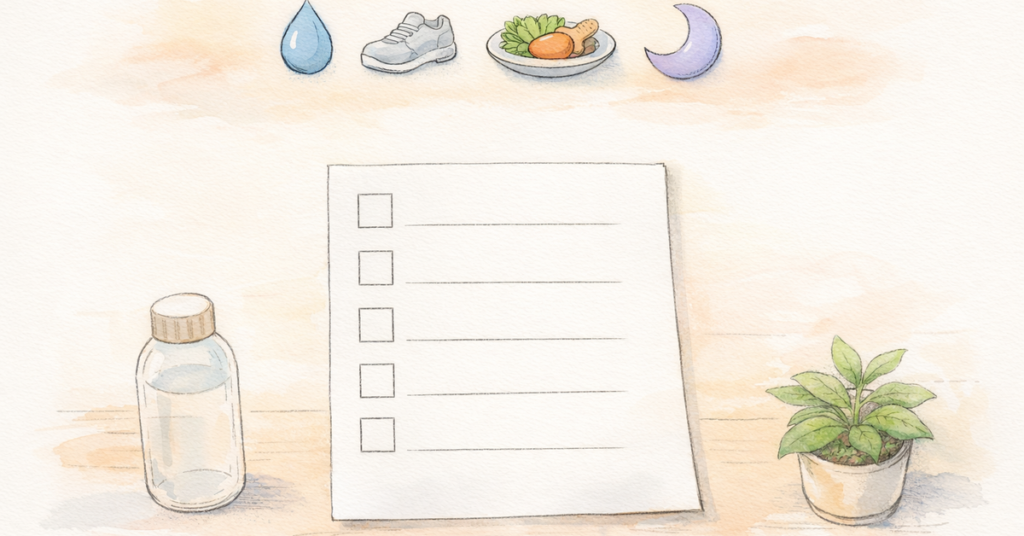
- hydration
- movement
- basic nutrition structure
- sleep wind-down
Once those become normal, everything else becomes easier.
Start with your “minimum baseline” (make it too easy to fail)
Your minimum baseline is the smallest version of your habit plan that still counts as a win.
This is the secret to staying consistent when motivation drops.
Examples of a minimum baseline
Pick one baseline for each category:
Movement baseline
- 5 minutes of movement (walk, stretch, or a short circuit)
- OR 1 round of your workout
Hydration baseline
- 1 glass of water before your first meal
Nutrition baseline
- Add protein + a fruit/vegetable to one meal.
Sleep baseline
- Start your wind-down 10 minutes earlier.
When life gets hectic, you don’t “skip the whole day.” You do your baseline and keep the streak alive.
Beginner rule: if your baseline feels “too easy,” that’s good. Easy habits get repeated. Repeated habits create results.
Pick 3 habit anchors (morning/midday/evening)
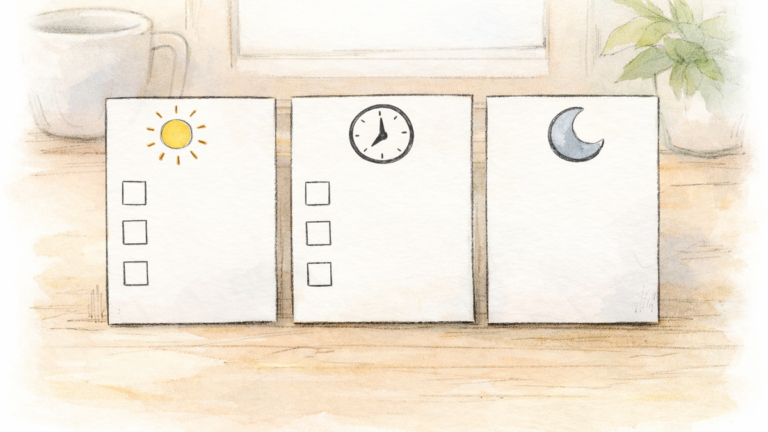
Anchors are habits you attach to parts of your day so you don’t rely on memory or motivation.
Morning anchor (start the day with a win)
Choose one:
- Drink water before coffee/breakfast.
- 2 minutes of breathing
- 5-minute walk/stretch
Midday anchor (keep momentum going)
Choose one:
- 10-minute walk break
- protein + color at lunch
- refill water bottle
Evening anchor (set yourself up for tomorrow)
Choose one:
- prep one simple meal component (protein, chopped veggies, fruit)
- set out workout clothes
- 10-minute wind-down (stretch + less screen time)
Why anchors work: they turn habits into a routine. You stop deciding every day.
The beginner habit stack (hydration + movement + protein/plants + sleep wind-down)
This is a beginner-friendly stack that you can repeat daily without feeling overwhelmed.
1) Hydration habit (simple and realistic)
- Drink one glass of water before your first meal
Optional upgrade: - Keep a water bottle visible where you spend time
2) Movement habit (minimum 10 minutes)
Choose one:
- 10-minute walk
- low-impact routine
- 10-minute beginner workout
The goal is not to destroy yourself. The goal is to build the habit of movement.
3) Protein + plants habit (simple meal structure)
Instead of strict dieting, use one simple rule:
- Protein + color at one meal daily
Examples: - eggs + berries
- chicken + salad
- Greek yogurt + fruit
- tofu + veggies
- beans + rice + veggies
This habit promotes balanced meals without making food a source of stress.
4) Sleep wind-down habit (10 minutes earlier)
Don’t try to overhaul your whole bedtime routine at once. Start with:
- a 10-minute wind-down
- lights dim
- stretch or breathe
- Put your phone away for a few minutes.
Better sleep supports better energy, reduced cravings, improved mood, and increased consistency.
How to stay consistent when motivation drops
Motivation is not the foundation. Systems are.
Here’s how to keep going even when you don’t feel like it:
Use the “baseline rule.”
On hard days, do the minimum baseline. Keep the habit alive.
Plan for the hard days (not the perfect days)
Ask yourself:
- What will I realistically do on a busy day?
- What will I do when I’m tired?
- What will I do when life is messy?
Then make that your plan.
Track your basics (so progress is visible)
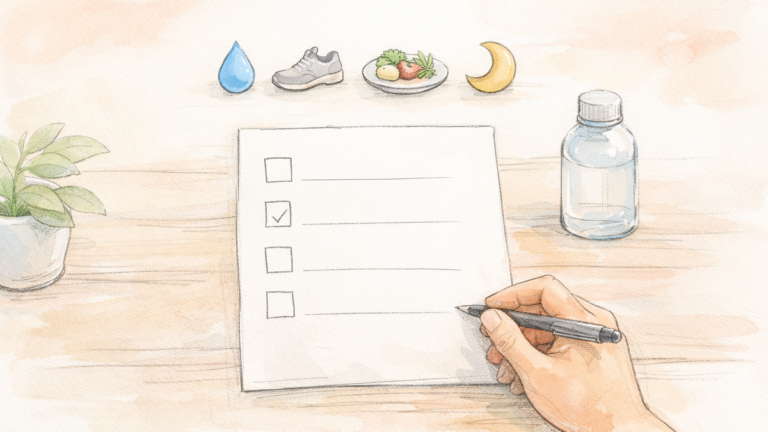
You don’t need complicated tracking. Use a simple checkmark system:
- water before the first meal
- 10 minutes of movement
- protein + color once
- wind-down started
If you want a simple tracking system inside Notion, see this guide:
Wellness Tracker Notion Template buying guide
Wellness Tracker Notion Template buying guide
Make habits frictionless
- Put your water bottle where you can see it.
- Keep workouts short
- Repeat the same meals often.
- Choose a consistent time for movement.
The easier it is to start, the more likely you are to continue.
Want a simple beginner plan you can follow without overthinking?
Download my free 7-Day Beginner Wellness Reset (Checklist + 3-Day Workout Plan)
It includes:
- a 7-day checklist
- daily focus prompts
- a 3-day beginner workout plan
- a habit tracker
- a simple meal template
Common mistakes to avoid
Mistake 1: Trying to change everything at once
Fix: choose 1–2 habits first, then build.
Mistake 2: Making habits too complicated
Fix: shorten the habit. “10 minutes” beats “60 minutes.”
Mistake 3: Restarting every Monday
Fix: restart today with your baseline. No waiting.
Mistake 4: Using motivation as the plan
Fix: use anchors + baseline + repeatable schedule.
Mistake 5: Expecting perfection
Fix: aim for “most days,” not “every day.”
Mistake 6: Not preparing for real life
Fix: create a Plan B for tired days (baseline).
Mistake 7: Skipping movement because you can’t do a full workout
Fix: walking and short workouts count.
A simple 7-day habit plan (example week)
Use this as your beginner week. Keep it light and repeatable.
Daily non-negotiables (baseline)
- Water before the first meal
- 10 minutes of movement (or 5 minutes on hard days)
- Protein + color at one meal
- 10-minute wind-down
Day 1 (Reset day)
- 10-minute walk
- Choose your morning/midday/evening anchors.
Day 2 (Strength day)
- 10-minute beginner workout or 1 round bodyweight circuit
Day 3 (Low-impact day)
- walk + stretch
Day 4 (Nutrition focus)
- protein + color at two meals (optional upgrade)
Day 5 (Strength day)
- Repeat Day 2
Day 6 (Lifestyle day)
- fun movement (walk, dance, light yoga)
Day 7 (Review day)
Ask:
- What habits felt easiest?
- What got in the way?
- What can I simplify next week?
Beginner wins: Repeat the same week. Don’t redesign your plan every 7 days.
FAQ
1) What are the best healthy habits to start with as a beginner?
Hydration, 10 minutes of movement, protein + color at one meal, and a short sleep wind-down.
2) How many habits should I start with?
Start with 2–4. More than that can feel overwhelming.
3) How long does it take to build a habit?
It varies, but most people notice momentum within 1–2 weeks. Repetition matters more than the exact number of days.
4) What if I miss a day?
Don’t restart. Do your baseline the next day and continue.
5) Do I need to work out every day to build healthy habits?
No. Beginners do well with 3 strength days per week plus walking/mobility on other days.
6) What if I don’t have time?
Use the baseline: 5–10 minutes still counts.
7) How do I stay consistent when I’m tired?
Lower the bar, don’t quit. Do the minimum baseline and keep the habit alive.
If you want a simple beginner system, you can follow daily:
Download my free 7-Day Beginner Wellness Reset (Checklist + 3-Day Workout Plan)
It includes:
- a 7-day checklist
- daily focus prompts
- a 3-day beginner workout plan
- a habit tracker
- a simple meal template
Pingback: Daily Habit Checklist For Beginners (Beginner Guide)
Pingback: Buy Notion Wellness Tracker — Complete Buying Guide
Pingback: Night Routine for Better Sleep (Step-by-Step Guide)
Pingback: Sleep Hygiene Tips for Beginners (Simple Guide)
Pingback: Morning Routine for Beginners Wellness (Simple Daily Guide)
Pingback: How Much Water Should I Drink Daily? Simple Guide
Pingback: How to Drink More Water Daily: Easy Beginner Habits
Pingback: Wellness Fitness Tracker Notion (Beginner Buying Guide)